#MadMen Recap: ‘Severance’ Grapples with ‘The Life Not Lived’ (SPOILERS)
Spoiler Alert: Do not read on if you haven’t seen “Mad Men” season 7, episode 8, titled “Severance.”
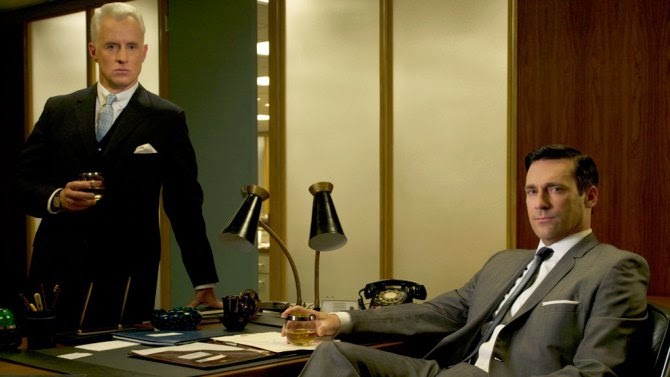
With its final season premiere, “Mad Men” serves up an ultra-rich
slice of layer cake that reminds us how much we’re going to miss this
show when it’s all over seven weeks from now.
“Severance,” written by series creator/exec producer
Matthew Weiner and directed by exec producer Scott Hornbacher, is
densely packed with detail, call backs to earlier points on the “Mad
Men” timeline and emotional moments in the lives of the core characters
that only a cast this good could pull off.
In sum, the storyline shows Don Draper and other core characters
grappling with what today would be called “work-life balance issues.”
Peggy, Joan and Ken in particular are wrestling with the question of how
their lives are defined by their jobs. Don Draper seems to be more
preoccupied by the existential question asked in musical form by Peggy
Lee at the start of the episode: “Is that all there is?”
Weiner is never one to drop story hints, but he has said that the
final seven episodes will revolve around the main characters searching
for answers to the what-it-all-means questions, now that they’ve each
achieved a measure of material success that allows them the luxury of
worrying about metaphysical concerns. And it’s true — as we reconnect
with the Sterling Cooper gang, the core players are in good shape from a
financial and social-status perspective. But each in their own way
seems to be searching for something deeper — even Pete Campbell reflects
on how his time in California seemed like a dream and didn’t really
change his life after all.
The opening sequence featuring models auditioning with fur coats
recalls Don Draper’s humble beginnings as an ad copy writer for a
furrier.
“Look at yourself. Do you like what you see?” Jon Hamm is pouring it
on with THAT VOICE, infusing it with all of his seductive charms. But
the question might just as well be aimed at him. We see that he is back
in Lothario mode, with a different girl on his arm every night and an
answering service overflowing with messages.
But he’s also still haunted by past liaisons, starting with his
hallucination/premonition about Rachel Menken, his affair from way back
in season one. She appears to him in a fantasy sequence with the ominous
message: “I’m supposed to tell you you missed your flight.”
When Don comes home to an empty apartment, he turns on the light to
see the chic decor that reflected Megan’s touch. He fixates on a
waitress at a diner because she reminds him of someone — the
schoolteacher Suzanne Farrell maybe?
Then Don learns that Rachel has died of leukemia, and it hits him hard.
Don is even more upset after his encounter with Rachel’s sister when
he goes to pay his respects at her memorial service. “I’m Don Draper.
I’m in advertising,” he tells her by way of an introduction. The sister
puts it together and is clearly none too happy to see him, which gives
us an indication of how the affair left Rachel years before. “I’m sorry.
I don’t know what you’re looking for here,” the sister tells Don. She’s
not in any mood to try to make him feel better.
The sight of Rachel’s young kids is a big ol’ mortality wake-up call to Don.
“She lived the life she wanted to live. She had everything,” the sister says, punctuating Don’s thoughts.
It’s interesting to see that when he’s in playboy mode, Don appears
to be more comfortable with himself than ever before. When he and Roger
escort three party-going girls to the diner, Don regales the table with
stories of Dick Whitman’s actual childhood. Roger even remarks that Don
loves to talk about growing up poor.
One of the most intriguing crumbs in the episode is the question of
why Betty’s earring shows up on Don’s bedroom floor, to be found by
Trisha from TWA moments after she destroys the white rug with a glass of
red wine (bad combo). Don assures her that the earring belongs to “the
woman I’m not sleeping with,” but it still begs the question.
Peggy and Joan are almost as front-and-center in this episode as Don.
As has often been the case, Peggy and Joan’s contrasting reactions to
experiences on the job serve to sharpen their characters. The
excruciating scene with three McCann-Erickson cretins making sexually
charged jokes reveals so much about both women. Peggy plasters a smile
on her face and soldiers on, focusing on the professional task at hand
no matter how sophomoric and insulting the men are. Joan is in the
firing line of their insults and can barely hide her disgust — so much
so she can barely speak in the meeting. It’s a humiliating reminder that
no matter what level of respect she reaches on paper in the
organization, and no matter how much she may have pocketed from the
buyout, she still can’t count on respect from men.
In the elevator ride afterward, Joan wants to “burn this place down,”
while Peggy is glad they got a “yes” despite what they endured. In an
instant, the differences between the two turn to hostility. Peggy
shockingly suggests Joan brings it on herself by dressing to accentuate
her figure. Joan responds in anger, prompting Peggy to reveal her
jealousy: “You’re filthy rich. You don’t have to do anything you don’t
want to do.”
Joan soothes her wounds with a shopping spree — but she still can’t
escape condescending attitudes or her past, when the shopgirl recognizes
her as having worked there and suggests she might still command her
employee discount.
Peggy, meanwhile, is lonelier than ever. She agrees to be set up on a
date by her underling — his brother-in-law, of course. To her surprise,
they hit it off so well that after a bottle of wine (or two) they hatch
a plan to go to Paris. She’s all for it — until she isn’t. When
she can’t find her passport, she uses it as an excuse to postpone the
trip. The next day, she finds it in her office — an apt metaphor for her
career-obsessed life. And Stan chides her for missing a chance to have
spontaneous fun.
Ken’s storyline features the most overt pointers to the theme of this
final half-season. First his wife tries to convince him to give up his
Sterling Cooper labors in favor of going off to a farm to write a novel.
She’s got a persuasive line of reasoning given the hunting mishap a few
seasons ago. “You gave them your eye. Don’t give them the rest of your
life,” she says. But he resists.
Lo and behold, the next day Ken gets the ax thanks to a grudge that
Sterling Cooper’s new parent company, McCann-Erickson, holds against
him. Roger Sterling, smarmy as ever, promises him a generous severance
package.
Ken is stunned by the immediate loss of identity — it’s one thing to
quit a job but another to be unapologetically fired — and also by the
strange coincidence of his wife’s plea and his father-in-law’s
retirement from Dow Chemical. When Don comes across him in the outer
lobby, Ken waxes on about “the life not lived.” Indeed. Yet even for
someone with a obvious alternative course to pursue, Ken jumps back into
the corporate
rat race at the first opportunity. It makes for a delicious moment with
Roger and Pete as he announces he’s Dow’s new head of advertising.
And no, he doesn’t plan to fire them. “It’s going to be way worse
than that. I’m going to be your client and I hate to tell you I’m going
to be very hard to please,” Ken smirks.
The closing scene in the diner when Don goes back to see the waitress
is confounding but also sticks with the work-life theme. She reminds
him that when people die “things get all mixed up” when he tells her
about Rachel’s passing, and he presses her again about why he seems to
recognize her. And then she explains why there’s such a huge gulf
between them, given everything that Don and his cohorts have been
dealing with in the episode.
“I just work here,” she tells him.
A few other random observations:
- Roger Sterling’s hair — a cross between Mark Twain and 1980s Ted Turner.
- Ted Chauogh — hints at being divorced or separated in inviting Don and others over for a drink at his place before they check out a show in the Village?
- Peggy soooo wants to be one of the guys. “You want a raise? Stop acting like a secretary,” she snaps at Mathis.
- Nastiness in the office isn’t limited to women. Harry Crane gets a dose from the Topaz pantyhose executive who calls him “Mr. Potato Head” in a meeting.
- Ray Wise adds a cool factor to any episode. Period. Especially when he’s emoting about Pop Tarts


Nhận xét
Đăng nhận xét